Action films are up there as the most iconic genre, and since the turn of the millennium, there have only been a handful of masterpieces.
We’ve all heard of Mad Max: Fury Road and The Dark Knight, so here are some niche picks to fill your boots.
Film News Blitz’s Oscar Trinick breaks down his 21st-century action favourites.
‘Exiled’
If there’s any one place that should be heralded as the greatest producer of action films, it’s Hong Kong.
Filmmakers such as Tsui Hark and John Woo dominated the game in the 80s, 90s and 2000s, with knock-out films such as Green Snake, The Killer, Bullet in the Head, and Knock Off.
My favourite of the bunch, however, is Johnnie To.
But more specifically, his 2006 buddy-action masterpiece Exiled.
The film follows a friendship being formed between an ex-gangster and two groups of hitmen, those out to protect him, and those who were sent to kill him.
What makes Hong Kong action films stand out amongst Western variants is their unparalleled commitment to explosive chaos.
They are never restricted by inherent realism per se, but indulge in the pandemonium of wild stunts and endless gunslinging madness, and yet they still find time to deliver rich stories that slip right into the corruption of Hong Kong’s politics, whether that of the police or gang relations.
Exiled showcases both sides of the coin with To’s eye for expertly blocked sequences of tension that then catapult into wild showdowns, never managing to sacrifice strong thematic through lines for showy set pieces; he’s always able to control the tonality of his work and deliver both simultaneously.
This is something that many Western filmmakers struggle to grasp. I mean, just watch this:
‘Miami Vice’ & ‘Blackhat’
The name Michael Mann is hardly niche to the mainstream action world, but he gets most commonly paired with his pre-2000s masterworks that include Heat, The Insider, Thief and Manhunter, when two pieces of his best work came out in the 21st century: Miami Vice in 2006 and Blackhat in 2015.
His 2006 adaptation of the iconic TV show he helped produce is arguably his best work, full stop.
Starring Colin Farrell, Jamie Foxx, Naomie Harris and Gong Li, the film charts a geopolitical web of boats, guns and drugs, starting in South Florida, and reaching through a range of Caribbean and South American countries.
Mann’s 21st-century work has seen him embrace the style of digital filmmaking in a manner few other filmmakers have mastered; the ultra-grainy and handheld camera work that defines the hallucinatory paranoia of such a city and line of business.
A super-sized snapshot of the capitalist Americas that draws from all the hazy lights, the antennas, and the phone vibrations in its modernising world.
A story of middling characters wading through a loose narrative driven by ambiguous intentions, where tangibility is slipping through the cracks of digitisation.
A constant stream of violence and surveillance that this century is leading us to, where total isolation is the only form of peace.
Nothing will ever top Collin Farrell’s delivery of: “I’m a fiend for Mojitos.”
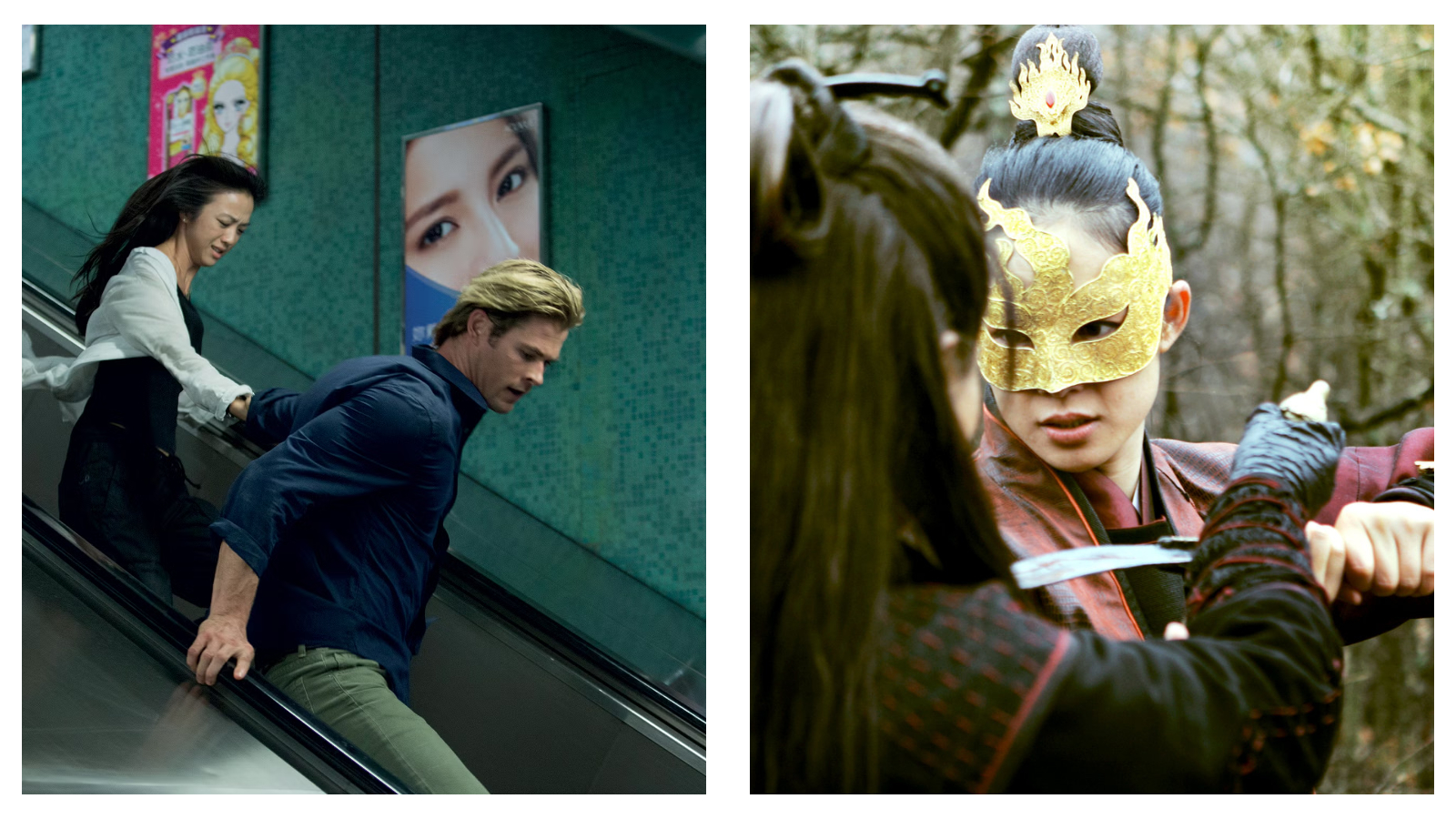
Mann’s 2015 Blackhat is a perfect spiritual successor to Miami Vice, and THE unsung masterpiece of his career.
Where that film shows us glimpses of a wider geopolitical world of violent business, Blackhat takes us on that journey, as we cross the States through to East Asia, only this time, drugs are swapped out for hacking geniuses and manic plans to topple the world’s markets.
The film stars Chris Hemsworth, Tang Wei, Viola Davis and Holt McCallany, as we follow the Americans and the Chinese partnering up with furloughed convict Nicholas Hathaway (Hemsworth), to hunt down a high-level cybercrime network.
A stark depiction of a capitalist doomsday that was about 10 years ahead of its time, whilst being noticeably slaughtered by critics and general audiences on its initial release, now become somewhat of a cult classic, an unsung masterpiece if you will.
Mann again favours the digital imagery in tandem with the world of computers, and again, the sense of surveillance that he is depicting.
Few films in Hollywood have been able to communicate their content through their form, but Blackhat and Miami Vice are amongst the only films that have complete success in that area. It’s the kind of risk that seems allergic to Western media nowadays, and yet many people didn’t even give it a chance.
If Miami Vice was the prerequisite warning, then Blackhat is the materialisation of such fears on a more global scale, where actions are reduced to binary, and data consumes all.
A film whose darkest fears are only conceptual exist beyond our tangible reality, yet the film’s nihilistic tendencies are fully realised.
‘The Assassin’
If you couldn’t tell already, I’m knee deep in my love for Asian cinema.
The Assassin is perhaps a bit of a rogue pick.
Directed by Taiwanese master Hou Hsiao-hsien, the film subverts the genre expectations of the martial arts legend of Wuxia.
In 9th-century China, a general’s daughter is abducted and transformed into a master assassin.
The Assassin is a film of unyielding patience, utilising the essence of what is known as ‘slow cinema’ through its still, observational style.
Its action isn’t even formally flashy, but it’s that juxtaposition which makes it stand on the action pedestal as one of the most unique things to come out of this millennium.
A film which takes the often maximalist traits of the Wuxia myth and asks it to return to its minimalistic roots in Chinese history.
Something devoid of fantasy, yet equally as compelling in its own tranquil way.
Its ability to overturn familiar stylistic choices is a marvel in its own right, but the way it forms something distinct within that is even more compelling.
READ NEXT – ‘Crime 101’ review: Mark Ruffalo elevates familiar crime caper