Last year’s black comedy, No Other Choice, was the highest regarded film out of South Korea, garnering minor awards buzz and finding strong standing among festival lineups.
Director Park Chan-Wook, returning to the screen for the first time since 2022’s Decision to Leave, tackles the hardships of the working man in South Korea; a bleak, yet humorous take on the many workers left coldly to their own devices amidst a rise in ‘technological efficiency’.
Originally released last September, No Other Choice is now widely available on MUBI after being rather hard to come by for a short while, and is based on a novel called The Ax by Donald Westlake.
Rating: ⭐⭐⭐⭐
The film, nominated for a Golden Lion as well as a Golden Globe for Best Musical or Comedy, follows laid-off paper expert Yoo Man-Su as he struggles to find his way back into his industry, deciding his only option is to kill all candidates for a job whose credentials he deems to have exceeded his.
Rational as ever, Man-Su finds his marriage, house, relationship with his children and freedom risked as he fights to maintain his way of life.
Titular conundrums
No Other Choice as a title could be described as a double, triple, quadruple or however-many-entendre, but the humour of Park’s abject cynicism starts at the title card: yes, he probably shouldn’t be trying to kill everyone else who is applying for a job, but are there any other jobs for Man-Su?
With the thought lingering that Lee Byung-Hun’s character’s dastardly plan could actually be, in the grand scheme of things, not an insane conclusion to come to, Park sets off from the first minute, establishing the uncomfortable, unfair and advantageous nature of South Korean employment.
Subtle, yet unsettling is the name of the game for the dark comedy; the opening scene will have the watcher squinting and jittering alongside Man-Su with an uncomfortable ray of sunlight deliberately beaming into the lens and into the lead’s eyes as he tries his hardest to scrape his way back into employment.
Directional successes
Park’s messing with perspective is the most impressive part of the film.
He will constantly offer flashes of other characters in the darkest parts of shots, occasionally jolt you upright with unexplained passages of time and generally make the film pretty hard to take your eyes off.
Everything is difficult for Man-Su, but everything is often behind him or off-camera, leaving the comedy with an almost pantomime-like quality as he struggles his way closer and closer to a concrete job prospect.
Terrible at his ‘job’
To be frank, as a killer, he sucks.
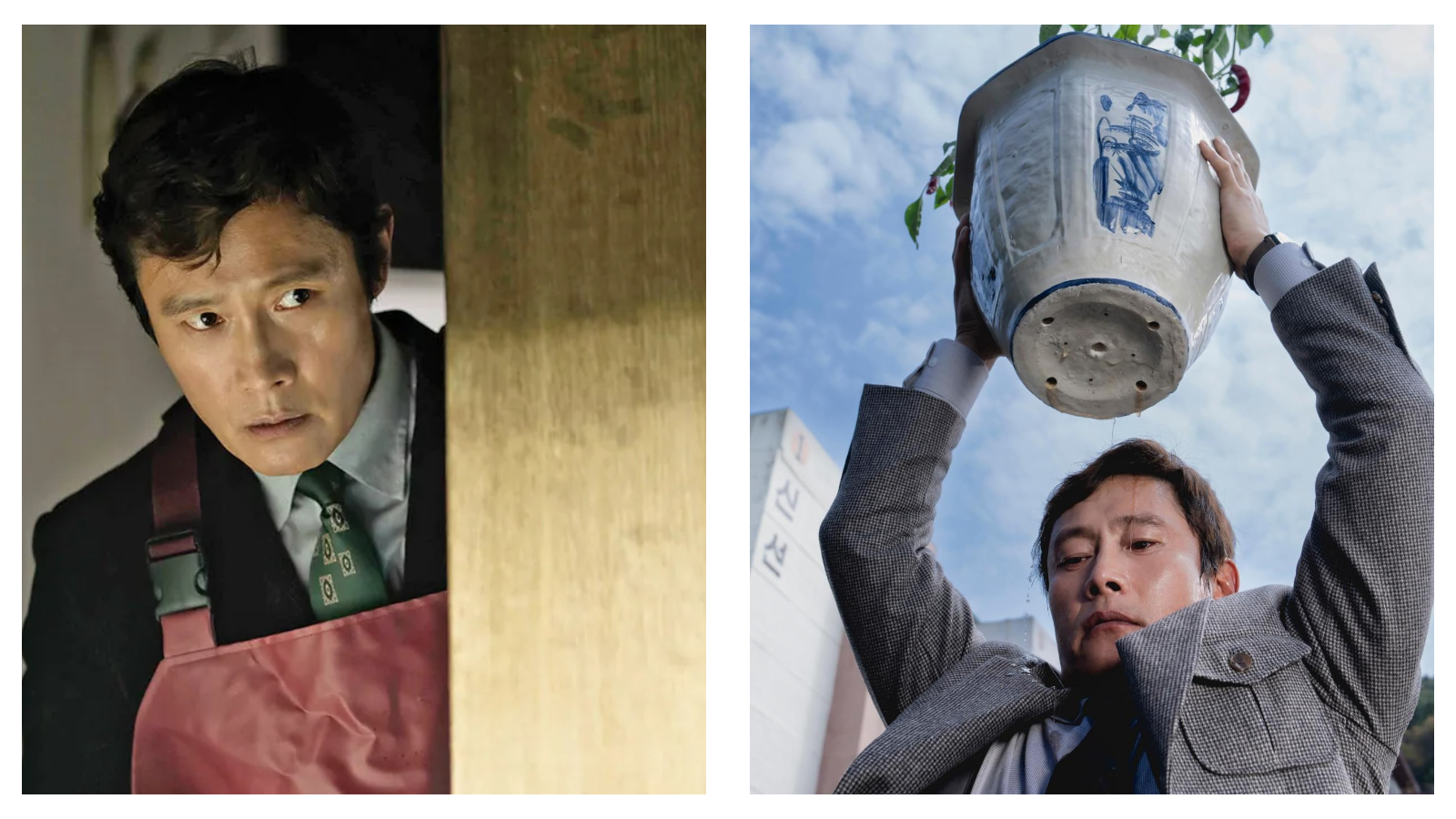
Man-Su’s first attempt at murder is a tough watch as he jealously teeters on the edge of an apartment building, holding an alarmingly heavy pot of chillies to drop on an employed industry fellow.
He is soundly rebuffed in his murderous ways by an old lady hanging her washing, unimpressed and asking for her pot of chillies back.
The ethical imbalance of the scene, also the poster for the film, epitomises Park’s two-tone approach to his angry representation of the state of his country; funny to watch, but quite frightening to truly consider.
‘Man-Su is not a murderer, he is just trying to preserve his family,’ is the argument thrust upon the viewer, and, with the departure of his dogs, the imminent foreclosure of his house and more, the argument is rather potent.
However, the film’s ethical grounding adds such a weight to his methods that you truly do almost understand him, while simultaneously highlighting just how mental that actually is.
Individuals impressing
An undeniably tough job to believably bring a character to life with such a complicated moral standpoint, Lee Byung-Hun must be highlighted as outstanding.
Pathetic at times, often confusing and occasionally genuinely frightening, Man-Su is a tough one to read, but Lee’s passionate, yet satirical portrayal of the epitomisation of the struggling ‘working man’ deserved much more praise than it actually got.
Lee was nominated for Best Actor – Musical or Comedy, with the film garnering a Best Motion Picture nomination in the same category at the Golden Globes, as well as a Best International Feature nod.
No wins, however, and little consideration for Oscar nominations is a bit of an injustice; the script is fantastic, and there can be very little complaint in any other aspect either.
As well, a surprise standout is the adulterous, crazed wife, A-ra, of Man-Su’s first victim: flatulent alcoholic has-been Beom-mo.
Portrayed by Yeom Hye-ran, the struggling actress is one who undeniably seems to take her profession into everyday life; each one of her scenes is laughably overblown, but realistically also one of the most important roots of the film.
A worthy cameo, with Son Ye-Jin’s portrayal of Man-Su’s desperate, yet loyal wife also deserving of more praise.
Not Park’s best, but not far off
It is quite a tough ask for anyone to outdo films like Oldboy, or The Handmaiden.
No Other Choice, Golden Lion-nominated and politically charged, is undeniably a damn good shot at some of the legendary director’s best, but an overwhelming feeling leaving the film is that it is a fantastic addition to Park’s film canon, but probably not a Mount Rushmore offering.
Whether that speaks to the quality of his previous work or to the film’s detriment is unknown, as No Other Choice doesn’t really have much wrong with it at all, but it just can’t stack up against some of the mammoth works the director has brought forth previously.
Park’s ‘state-of-our-country’ take is one of twists, turns and a confusing amalgamation of sympathy and disgust, but regardless of who you can empathise with, the real enemy here is South Korea’s dysfunction.
READ NEXT – Film trailers: Malkovich and Rockwell are CIA agents in ‘Wild Horse Nine’