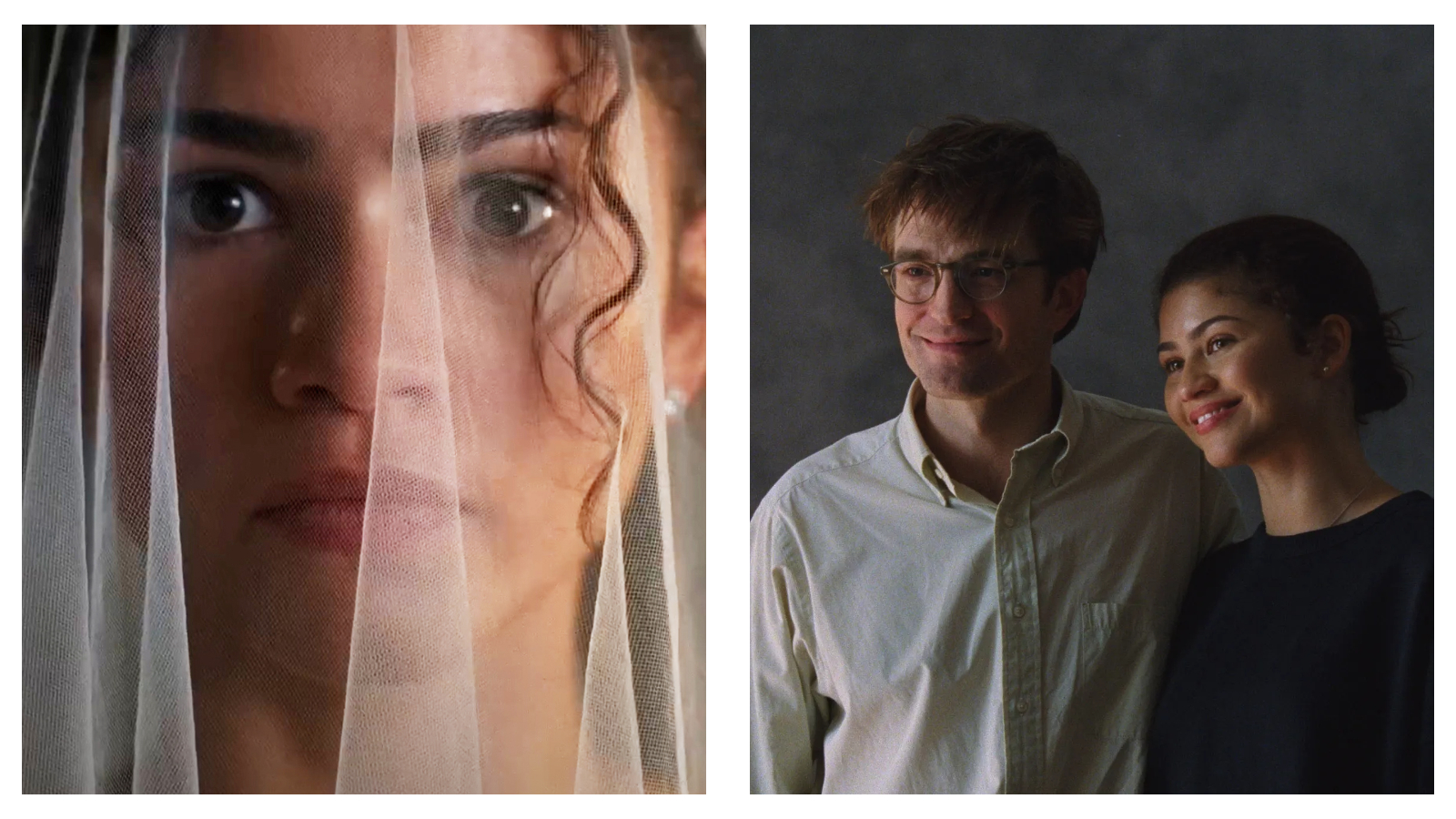
In a world where we’re often told to accept imperfections and flaws within the difficult intricacies of a connection, director Kristoffer Borgli’s The Drama is a masterpiece that will leave you questioning the boundaries that we are willing to compromise, or in this case, accept for love.
Film News Blitz writer Disha S. Charan takes a look at this eccentric dark comedy (spoilers ahead).
Rating: ⭐⭐⭐.5
The Drama is a recently released romantic dark comedy film written and directed by Borgli, which stars Zendaya as Emma Hardwood, a publisher and Robert Pattinson as Charlie, a British museum director living a normal life in Boston.
They’re portrayed as a happily engaged couple whose relationship is tested by an unexpected revelation during the week before their wedding, when Emma nonchalantly reveals she once planned a mass school shooting during a casual conversation with their maid of honour, Rachel and best man, Mike, when everybody’s asked to reveal their deepest, darkest secret.
For a film that’s promoted as a romantic comedy/drama, it takes honesty within love to a whole other level.
A24: Celebrating imperfections
Once again, A24’s signature usage of diving into ‘we are only human’ perspectives shines through in this film, which starts on an endearing note and later escalates into a bubble of relatable possibilities and choices that may look contrary to traditional rom-com plots, which use rational decisions that often lead to happy endings.
However, The Drama embraces the humanity of the connections portrayed on screen, a recurrent theme we noticed in Materialists.
It pushes boundaries between what’s moral and immoral as we dive into the mental repercussions of lived experiences through Charlie and Emma as they awkwardly struggle to wrap their heads around this secret during their wedding week.
According to The Tab, filmmaker Borgli told the Popcorn Podcast, “It doesn’t look at the societal level of deciding where your lines are, where the line for unconditional love is.
“The film focuses more on your own boundaries and how honest and imperfect you can be in your most intimate lives.
“Discussions in public are completely different. This one is too large for me.
“Basically, you won’t get a definitive response about who is correct or incorrect in this situation. It is up to you to choose what is forgivable because the movie leans toward the grey zones.”
Intentional decisions
Every shot seems intentional, with every scene being a visual treat as we see Charlie walking hand in hand with Emma’s younger self, whom he seemingly is trying to understand during the chaos after the secret is revealed.
You can clearly see his character descend into madness as he struggles to convince his friends that Emma’s intentions aren’t wrong.
It is quite interesting to see Charlie questioning whether he should still marry Emma despite her dark past, and as an audience, we are evaluating Emma too.
Does the weight of her decision to not go through with it prevail over the fact of her younger self’s choice to plan it in the first place?
Serious themes addressed
Emma explains that she planned the shooting when she was a lonely teenager who was drawn to online groups about gun violence because it appealed to her as it seemed ‘cool’ at the time.
However, after witnessing how another mass shooting negatively impacted her school, she instead began advocating for gun control and decided not to go ahead with her plan.
Cut to the present, we see a very visibly uncomfortable Emma struggling to talk about it with Charlie, who grows more precariously paranoid regarding her mental state and starts fixating on little moments in time where she has shown any signs of violence during their relationship.
Given themes as serious as mass shootings and gun violence exist in the film, the filmmaker’s choice to market the movie as a romantic drama or a lighthearted tale, frequently using wedding-themed marketing, such as Zendaya matching her movie promotion outfits with those of a wedding, wearing something borrowed, something new, and something old, and featuring the leads in bridal attire, can seem ambivalent.
The boundaries between right and wrong
While at work, Charlie asks his coworker Misha what she would do if she learned her partner, Blake, had planned a school shooting as a child.
When Misha responds with an answer he wasn’t anticipating, an agitated Charlie storms out and breaks down in tears.
Amid his despair, Charlie is unfaithful as he and Misha engage in a brief, energetic embrace.
Charlie catches himself when he realises what he’s doing.
The final act cuts to the wedding, and Rachel, who has not been speaking with Emma since she revealed her secret, passive-aggressively makes a toast about Charlie’s open-mindedness and acceptance.
This hints at the director’s notion about accepting one’s own boundaries, as we sense Rachel’s judgment of his decision to accept and marry Emma despite her past.
Things escalate, and we see an emotionally drained Charlie, covered in bruises and blood, running back to the apartment he shares with Emma, who is nowhere to be found.
The ending: An open book left unfinished
After the wedding debacle, Charlie goes and sits down at the very diner he once promised Emma they’d go to after their wedding, accepting his fate surrounded by the common sounds you’d usually hear at 2 AM in a fast-food restaurant.
Without any dramatic background music or sound effects, this gives viewers an immersive, realistic experience as if we’re sitting down with Charlie, too.
Suddenly, walks into the diner and takes a seat with Charlie, and the duo act out a meet-cute, something Pattinson’s character resented trying out earlier on in the story.
Borgli ends the movie like an open book, to be interpreted and read by the audience.
Neither Emma nor Charlie is right; they are deeply flawed human beings who, despite everything, find their happiness in each other and accept the difficulties it takes to make a relationship work.
I would also assert that Borgli smartly portrays Charlie’s boundaries and self-love throughout the film as we witness him spend the entire film trying to find reasons to understand Emma’s decision, even though the people around him rule her out as a ‘psychopath’.
In the end, he ends up making morally wrong mistakes himself, to the point where you’re intrigued to wonder: ‘Did Charlie accept Emma’s secret because he finally understands being misunderstood after cheating and making a moral wrong himself?’
Is love truly honest?
A24 has done a splendid job of encouraging the audience to truly question the boundaries they hold for themselves, and how far they’re willing to go for love in the name of honesty.
To love someone is to accept the worst in them, but would you still love them if the person you were about to marry in one week revealed a serious secret that changed the way you saw them?
We’re often taught to encourage values and integrity within relationships, but it’s a complex endeavour to accept one’s intrusive thoughts, let alone actions, so can you blame Charlie’s decisions as a spectator?
The Drama certainly lives up to its name.
READ NEXT – ‘Pretty Lethal’ review: Vicky Jewson’s film is full of guts and gore