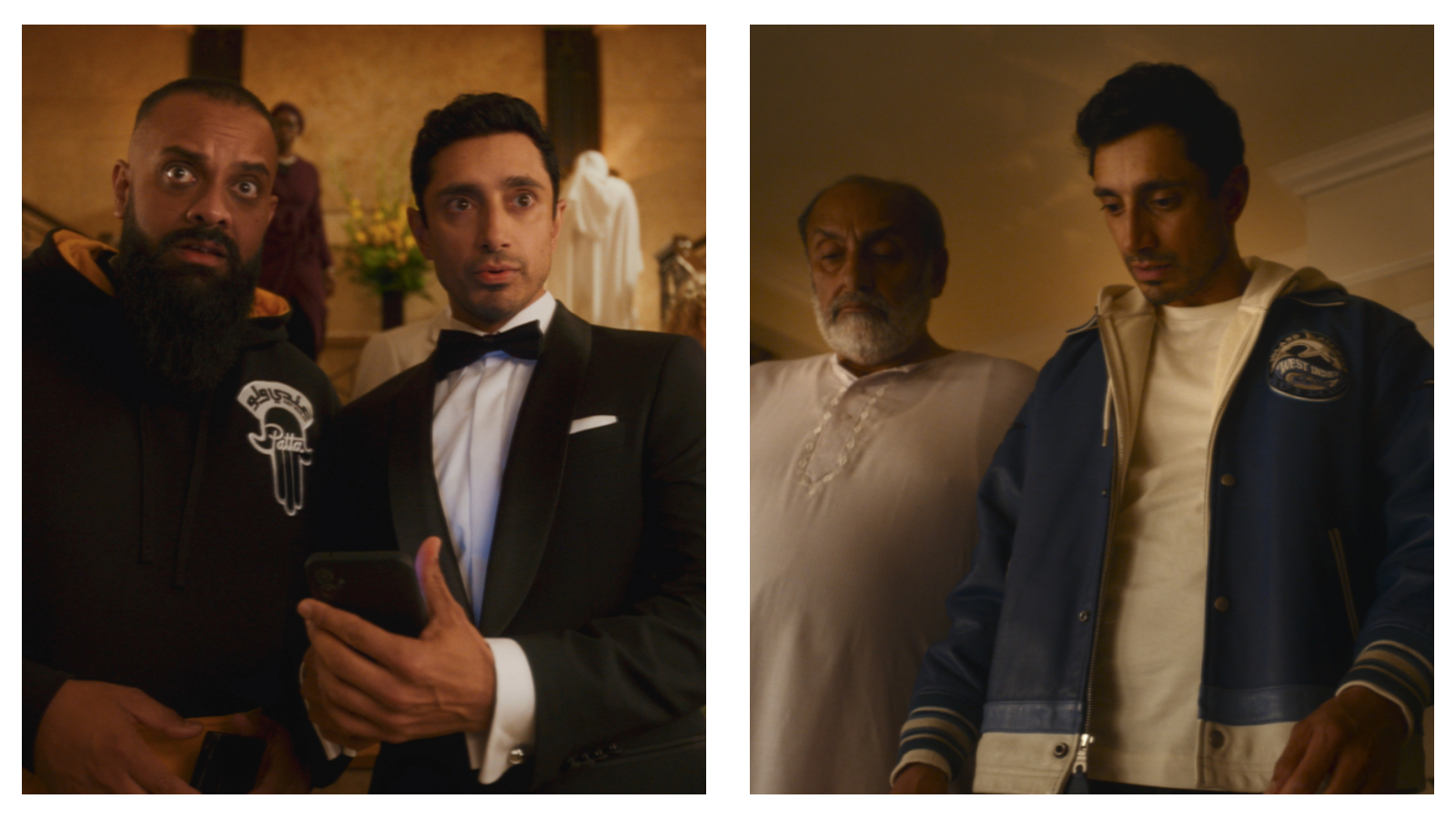
On 25 March 2026, Bait released its six episodes on Prime Video. The dark comedy was created by, written by and stars Emmy award-winning Riz Ahmed.
“Are you going to be the next James Bond?”
Bait is a semi-autobiographical satire that focuses on struggling British actor Shah Latif (Ahmed) as he vies for the role of the next James Bond.
While hoping to land his big break, the actor’s life spirals out of control as he struggles under familial and media pressure.
What ensues is a thought-provoking, hilarious and absurd depiction of Shah’s grasp on identity. Spoilers to come!
Rating: ★★★★
Why is the show called ‘Bait’?
The show’s multi-layered title speaks to the themes it engages with, and the various meanings of “bait” are reflected in the episodes’ titles.
Episode 2: ‘TO TROLL, TO PROVOKE’
In UK slang, “bait” can mean attention-seeking. This works hand in hand with Gen Z’s use of “bait” particularly on social media to mean intentionally provocative to garner a reaction.
Here, “bait” reflects Shah’s yearning for fame while trying to manipulate the ever-fickle media to his advantage.
Episode 3: ‘HOUSE OR HOME’
In Arabic and Hebrew, “bayt” and “bayit” or “beit” mean home, prompting the title’s deeper cultural significance.
Shah’s sense of identity is deeply tied to his familial roots, and his relationship with his family is a core part of the show.
Episode 4: ‘LOYALTY, ALLEGIANCE’
In Urdu, “bai’at” directly refers to loyalty and allegiance, the title of the fourth episode.
This is a character trait that Shah finds to be heavily tested throughout the show’s events. He grapples with his loyalty to his family, his community and even his own character.
Episode 5: ‘LURE, PART OF A TRAP’
Finally, there is the most literal meaning of “bait,” something used to lure.
Here, the darker, more thriller aspects of the show are brought into focus, as Shah must deal with the consequences of his desires and choices.
The structure of ‘Bait’
Bait is formatted to be six episodes long, with each episode running for approximately 20-30 minutes.
The course of the show takes place over only four days, following Shah’s failed Bond audition to his second successful one.
This sets the series up at a rapid pace, where each shot and line of dialogue is heavy with intention.
Each episode brings on a new personal challenge for Shah. He experiences a complete breakdown as he grapples with his grasp on his identity and priorities.
How ‘Bait’ uses genre and style
What makes the show particularly compelling is not only how the format aids the story, but also how it bends genre to engage with different stylistic elements.
In an interview with JoySauce, Ahmed commented: “It’s got all that mix of genres—from spy thriller to family drama to comedy, that’s everything I like in one place.”
When family is centred as they celebrate Eid, the show takes inspiration from Bollywood cinema conventions.
As a rival family member, Salim, joins the gathering, the saturation is amped up. There are rapid zooms onto narrowed eyes. Salim does a series of acrobatic tricks and walks on water.
But then: “Uncle and aunty want to go raving.”
The next episode slips happily into romantic comedy mode, flashing rave lights and slow-motion dancing.
‘Bait’ doesn’t let its audience settle, though, quickly moving into a spy thriller. Here, it’s all shaky cam, surveillance shots and timestamps.
Thus, the audience viscerally feels the pull of the different roles Shah takes on.
The exploration of identity in ‘Bait’
The show opens in a darkened room. A man, suited up, stands as a gun is pointed at him.
Anticipation builds.
“Line!” The man calls out.
The tension falls away as the rest of the film set is revealed, crew and director frustrated. Shah knows he has just blown his shot at being James Bond.
As Shah faces more practical challenges in his attempt to reaudition for the part, the core of his struggle comes from his loss of identity.
Bait explores the burden of representation, where as part of a minority group Shah must juggle his personal career goals as well as those of his community.
Can he take on a historically white and exclusionary role without selling out?
While trying to find an answer for that, he faces hate from within his own community, as well as outside of it.
This strife is captured perfectly with intercut shots of his family praying during Eid and him upstairs holding his head in his hands as he struggles with the guilt of ignoring a fan.
Pigtrick Stewart and surrealism in ‘Bait’
Yes, Bait really has a pig’s head canonically voiced by Patrick Stewart.
Thrown into Shah’s home in a racist protest against him taking on Bond, the pig’s head becomes an important facet in Shah’s navigation of identity.
In an interesting use of surrealism, Shah “talks” to the pig’s head as a manifestation of his critical inner voice.
By the end, the pig simply wants him to surrender to the Bond version of himself.
Shah lives through dream sequences of himself embodying Bond: a fight sequence with all those who have wronged him, including the old women who insisted he was not as tall as Dev Patel, as well as him executing his family.
‘Bait’ plays with surrealism to aid Shah in his journey to revelation, ultimately coming to terms with his loss of identity and prioritising his family.
Shah, are you acting?
Yasmin, Shah’s ex-girlfriend, asks him if he’s acting after he recites his lines in place of a vulnerable confession.
“They are lines, but the feeling is honest,” Shah responds.
Bait thus highlights the tumultuous relationship between the public and the private for Shah.
In an interview with Zeteo, Ahmed commented on this gap between one’s public and private identity.
“The show is grown out of things that take place within that gap. How we want to be seen and who we really are,” Ahmed said.
“Tell me, when it’s just you all alone, do you even know who you are?” Shah is asked as Bond.
“I don’t live with myself. I live with whoever you need me to be. If I don’t know who I am, it’s because you don’t want to know,” he replies.
This sums up Shah’s core inner conflict: due to his identity and ambition in a Western-centric entertainment industry, he feels to be always performing some kind of role.
Throughout the show, he continually tells people to call him Shah rather than his full name.
Though when asked to introduce himself as Bond after his second audition, he looks into the camera and says: “The name’s Shahjehan.”
Ultimately, the show ends with him taking a step towards authenticity.
With a second season neither confirmed nor denied, do yourself a favour and watch season one of Bait, available on Prime Video now.
READ NEXT – TV trailers: Apple drops first ‘Ted Lasso’ season four teaser