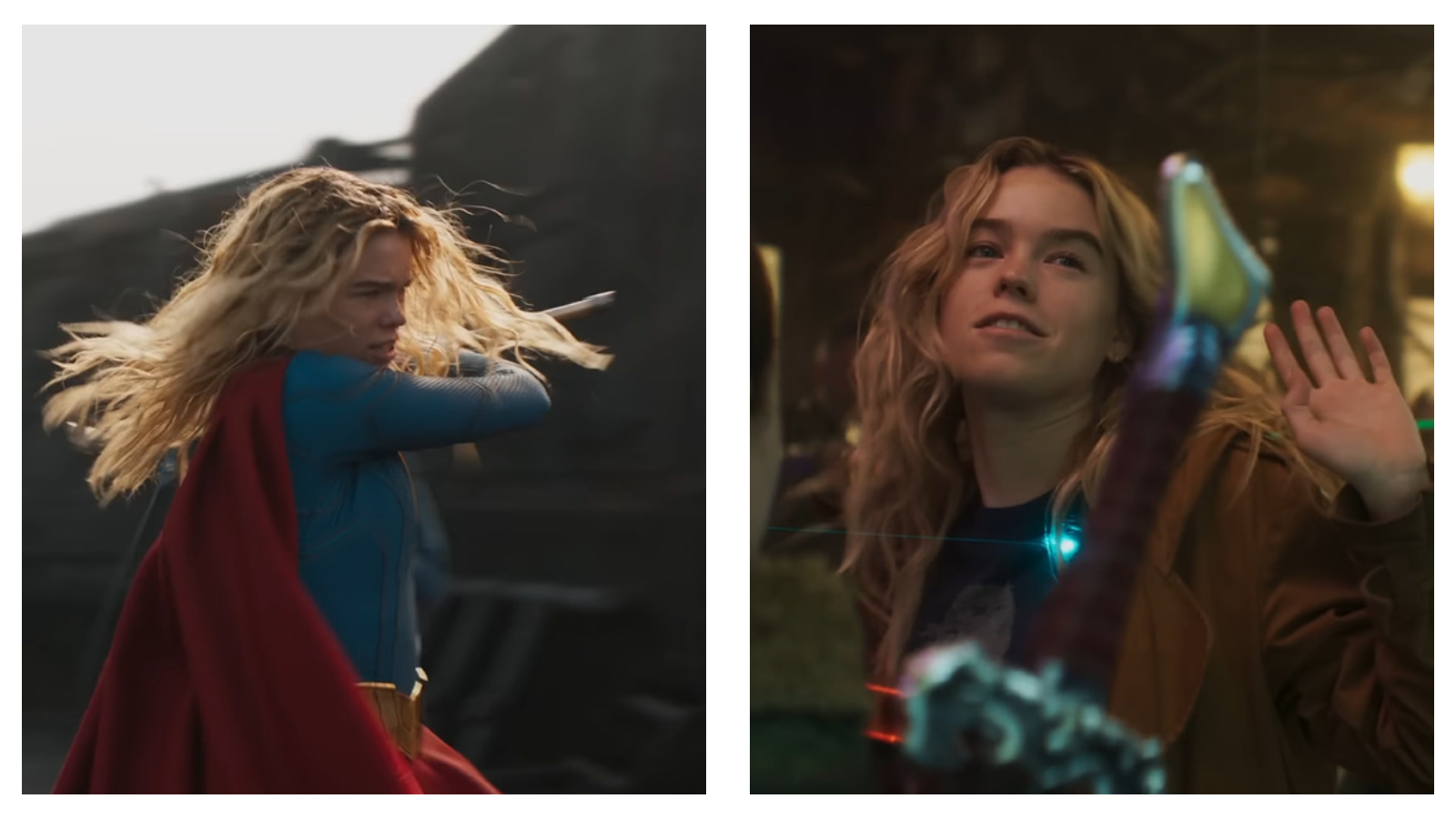
Milly Alcock has finally arrived in cinemas as a comic book heroine thanks to the release of Supergirl, a compelling entry in the fledgling DC Universe (DCU).
This is the second big-screen adventure spearheaded by DC Studios co-chiefs James Gunn and Peter Safran, following 2025’s Superman.
David Corenswet’s Man of Steel returns in this flick, where girl power takes centre stage.
What is ‘Supergirl’ about?
Directed by Craig Gillespie (I, Tonya) and written by Ana Nogueira, Supergirl is based on the 2021 eight-issue Tom King and Bilquis Evely limited comic series, Supergirl: Woman of Tomorrow.
It finds Alcock’s Kara Zor-El, Superman’s cousin, drinking away her past trauma while celebrating her 23rd birthday, utilising the de-powering effect of a red sun planet to get inebriated.
Her story intertwines with Ruthye Marye Knoll’s (Eve Ridley), whose family is killed by the villainous Krem (Matthias Schoenaerts).
After initially rejecting Ruthye’s plea to help enact revenge upon Krem, Kara is dragged into the vengeful adventure when the villain of the piece poisons her beloved dog Krypto.
From here, the two leading ladies planet hop in pursuit of Krem to avenge those they’ve lost and save Kyrpto, the loyal super-dog.
Meanwhile, Superman/Clark Kent is back on Earth, periodically sending video calls to urge Kara to return to Metropolis.
Jason Momoa’s bow as interstellar bounty hunter Lobo also makes a mark, as Kara grapples with the trauma of losing her home planet, Krypton, and the burden of becoming a hero.
Alcock is a strong leading lady
Alcock’s performance at the centre of this film is its strongest feature.
Equal parts cocky and endearing, her haphazard, figure it out along the way approach translates well from the screen and into theatres.
Alcock is the imperfect hero, and her turn as Kara/Supergirl makes for a believable performance.
What’s more, Kara has shades of light and dark that make her far more rounded than Clark Kent as an individual.
Nogueira’s screenplay features strong themes that place Kara in situations where she must liberate women oppressed by male violence.
That’s a big topic to tackle in a summer mainstream movie, but it is presented with sleight of hand and woven neatly into the narrative.
Moreover, the structure of this screenplay is far more familiar to cinema audiences compared to the relentless, breakneck pacing in Superman.
Personal preference will dictate whether that’s a good or a bad thing, but overall, Supergirl hummed along well enough.
Pitfalls
As with any initial superhero film outing, the final act of Supergirl feels fairly by-the-numbers: overcome adversity, clash with the villain, fight montages, heroic resolution.
It also isn’t Supergirl’s fault, but the sheer volume of superhero films across the last 20 years means this final act lacks sparkle.
Momoa’s Lobo, while entertaining, feels like a strange fit within the film, more of an easter egg for future appearances rather than an essential part of the narrative.
Lobo is also dropped in and out at key moments as a form of cackling, cigar-smoking plot armour.
The verdict
Another curious element to Supergirl is its sense of scale, which seems at odds with the blockbuster-style marketing campaign.
In truth, this is a far smaller film compared to Superman, which had several world-threatening plates to spin in a larger-than-life story.
Supergirl, meanwhile, is practically a two-hand road movie, and that works in its favour, perhaps not when it comes to box office returns though.
It’s a satisfying watch at the end of the day, but by no means breaks the mould.
Instead, Supergirl is a solid foundation on which Alcock can build her compelling character throughout the DCU.
Here’s to further exploration of the light and shade in Kara’s self-discovery of heroism.
Rating: 6.5/10
READ NEXT – Film analysis: Everything you need to know about ‘Supergirl’