There’s a reason that Steven Spielberg’s Jurassic Park has remained the best entry in the now-bloated franchise.
That reason is how the legendary filmmaker demonstrates his nigh-on unmatched ability to craft incredible moments of tension.
Drawing on the lessons he learned making Jaws, undoubtedly one of the greatest Hollywood blockbusters of all time, Spielberg is in his element when he reveals the monstrous T-Rex for the first time in Jurassic Park.
Laying the groundwork
Unlike today’s attention-starved society, cinema audiences in the 1990s were a more patient breed.
That’s why Jurassic Park can get away with taking its time to turn up the ante.
Rather than go for the jugular straight away, Spielberg’s film gives you time to learn about the characters in detail, to care for them, understand their motivations and why they’re at the park in the first place.
Moreover, seeds are sown as the park is revealed under a positive lens, showcasing its beauty rather than its dangers.
All of this means that it’s not until just over an hour into the film that the T-Rex prepares to make its grand entrance.
This wasn’t an uncommon thing for films in the 20th century; Aliens takes a similar amount of time before the titular beasties start running amok, and Spielberg’s own Jaws waits until the second act to give you a full glimpse of the shark.
The success of this approach is that the payoff is doubly significant.
The fragmented reveal
When the time comes, Spielberg uses a whole bag of tricks to heighten the dramatic tension and make the T-Rex reveal as impactful as possible.
It begins with the location, back at the beast’s main enclosure where the core characters were toured through earlier on, only to miss seeing the creature at all, despite a tasty goat being offered up.
Boom, boom, boom…
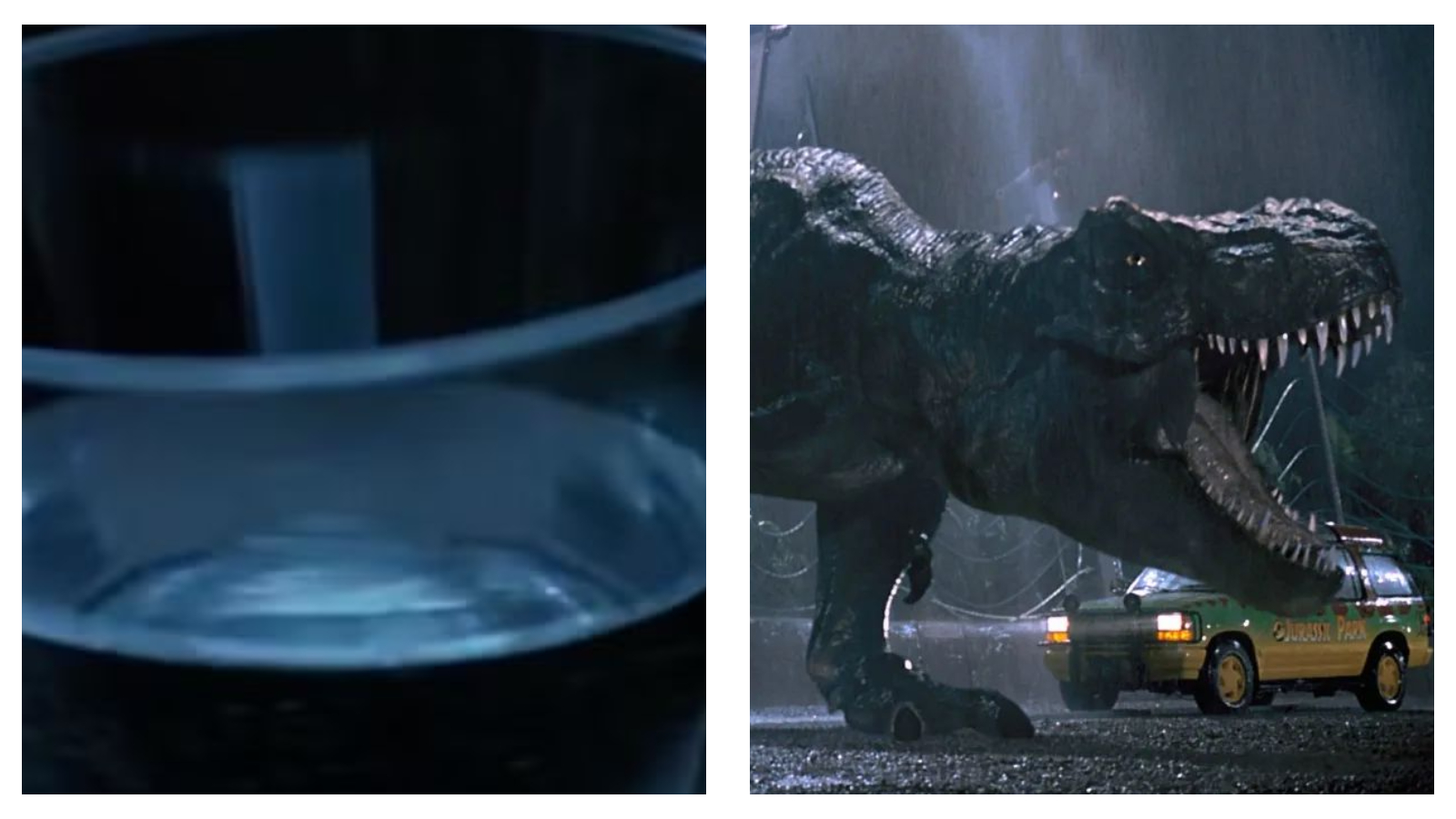
The sound of heavy footsteps, faint at first, but building. This is our first clue that something is coming.
Then a close-up of a cup of water, shaking with every distant footstep, calling back to Jeff Goldblum’s Malcolm explaining chaos theory.
Martin Ferrero’s Gennaro, stuck with the two child characters in a park tour SUV, is the next to take notice.
Eyes wide, looking in the shaking rear-view mirror.
“Maybe it’s the power trying to come back on,” he whispers, although both he and the audience know what is actually coming.
Spielberg is building up to his big moment with each juicy layer of detail.
Next, Joseph Mazzello’s Tim uses night vision goggles to look into the enclosure, and we see the goat is no longer chained up, but gone.
“Where’s the goat?”
Bam! A severed leg hits the sunroof of the jeep; we tilt up to see the T-Rex for the first time, but just from the neck up as it swallows down the rest of its meal.
The magic moment
Gennaro runs for the nearby toilet cubicle at this point, and Spielberg momentarily breaks the tension with light humour, as Malcom observes from the second jeep, “When you gotta go, you gotta go.”
Things turn up to 11 at this point when he and Sam Neill’s Dr Grant become aware of the looming threat.
The fence cables snap, twist and bend before we pull away to reveal the T-Rex in all of its glory.
It’s a CGI marvel of its time (1993), an imposing, thunderous image, and it pays off with extra bags of whallop to bring an end to two breathtaking minutes of mounting tension.
All you can do as an audience member is sit back in stunned silence as a gleeful smile creeps across your face as the cinematic mastery unfolds.
From there, you buckle up, strap in and let Spielberg deliver the ensuing chaos of Jurassic Park.
READ NEXT – Film stories: A Manchester Odyssey, there and back again for Nolan’s epic