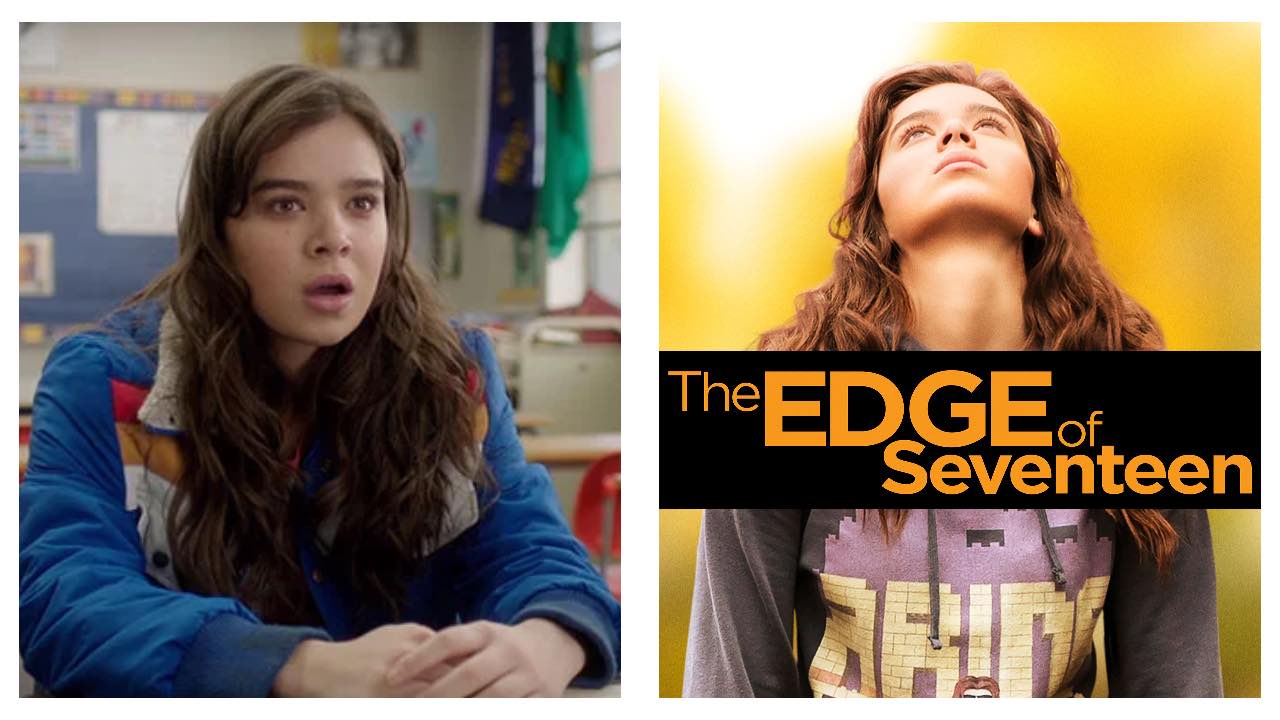
The Edge of Seventeen is a coming-of-age film that follows high school junior Nadine (Hailee Steinfeld) as she juggles feelings of isolation.
Nadine’s friendship with her best friend, Krista (Haley Lu Richardson), is the only stable relationship in her life. However, everything changes when she starts dating Nadine’s popular older brother, Darian (Blake Jenner).
It’s this intense feeling of betrayal that is core to the plot of the film, as it is the catalyst to Nadine’s loneliness and insecurity deepening, resulting in further isolation, as Film News Blitz’s Darshan Kaur Gill explores.
Catastrophic adolescent experiences
The film manages to capture something that other coming–of–age films miss: being a teenager isn’t just dramatic – the events that take place during that phase of life can feel catastrophic.
Nadine’s feeling of betrayal when she discovers her brother’s relationship with her best friend is like a collapse of a reality that was barely being held together in the first place.
Although the event is survivable, the film treats it as if it is the start of the apocalypse, where reality is turned upside down and flipped into something unrecognisable.
This is something that can be dismissed by adult viewers as immaturity or narcissism, but the film actually quietly argues the opposite; adolescence magnifies feelings because teenagers are still constructing themselves and their sense of self.
Heightened emotions
Emotions are so much more heightened, especially feelings of betrayal, due to relationships being so integral to the teenage experience.
Friendships feel like the be-all and end-all, not something that can be supplemented in but something that is an integral foundation to who teenagers will become.
Krista, therefore, isn’t just Nadine’s friend, but her emotional stabilizer, allowing Nadine to see herself as funny and lovable, and losing exclusive access to that relationship, to her more popular older brother at that, feels like erasure rather than jealousy.
If Krista chooses to be with Darian, it means that Nadine no longer has the same place in her life, and that her emotional place in Krista’s universe becomes uncertain.
This is why teenage betrayal feels so uniquely annihilating.
The teenage weight of unsurvivable tragedy
Teenagers often don’t have the evidence that pain is survivable.
Adults possess the understanding that friendships can rupture and re-form, and that identities can evolve due to previous experiences.
Teenagers, by contrast, can’t do the same as they don’t have the perspective, therefore they experience many losses as unprecedented.
The film captures this through Nadine’s disproportionate emotional logic.
Every humiliation feels like destiny, every rejection confirms that she’s permanently unlovable, and ordinary disappointments are interpreted as complete truths because being a teenager demands that everything be black and white.
Growing up and growing apart
What makes the betrayal in The Edge of Seventeen especially painful is that it exposes a truth that teenagers are rarely prepared for, which is that the people you love most have desires and loyalties independent of their relationship with you.
Nadine wants to freeze Krista inside the role she serves in her life, but this is something that she struggles with understanding in the film: people are independent of the roles they play in others’ lives.
The betrayal feels like the start of an apocalypse that is ever-looming, but never fully forming.
Nadine survives, not because the betrayal stops hurting, but because she discovers that identity is not based on who a person is in another’s attention.
The end of adolescence begins when negative emotions no longer feel synonymous with catastrophe and annihilation.
The film ultimately suggests that growing up is learning that pain, hurt and betrayal are not the end of the world, even when it truly seems to be.
READ NEXT: Film analysis: Why Hollywood still struggles to imagine women as protagonists