Christopher Nolan might be a name you’ve heard before – some even call him the best filmmaker of all time.
Throughout his career he has directed 13 feature length films, but which of these are truly the ones worth watching?
Read on to find out Film News Blitz writer Priya O’Reilly’s top five films.
‘The Odyssey’ (2026)
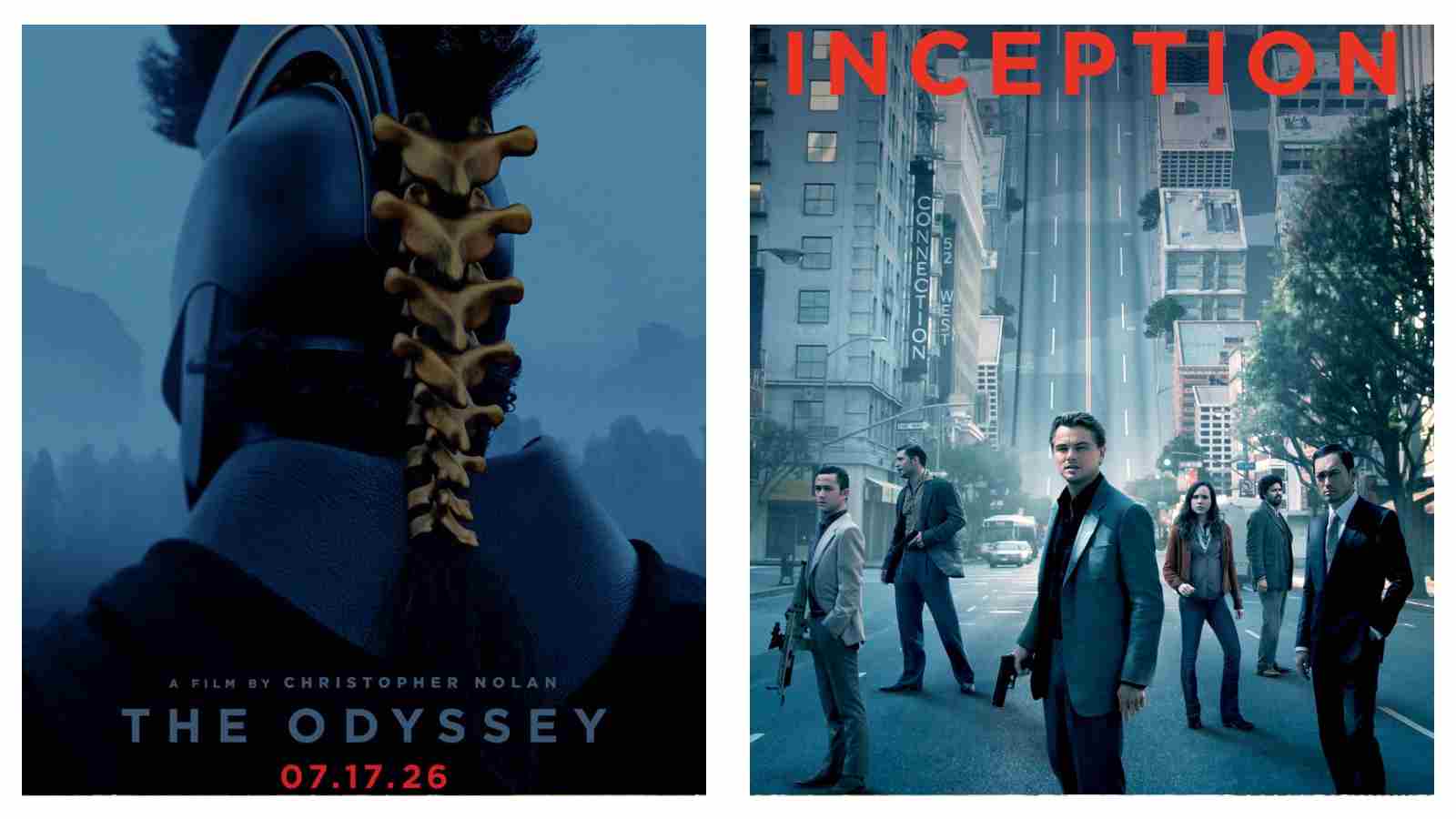
The Odyssey is Nolan’s newest release and hit theatres on 17 July.
It has received endless praise, scoring 94% on Rotten Tomatoes and being called “a colossal masterpiece” by critics.
The cast features A-listers such as Matt Damon, Tom Holland and Anne Hathaway, who deliver “power performances”.
The story is based on Homer’s epic poem The Odyssey and follows the story of Odysseus, the king of Ithaca and veteran of the Trojan War.
The tale follows his journey back home after their victory at Troy… but their return is anything but easy.
The film has earned a record-breaking global opening at the box office, generating $303 million in the first week.
And it has since hit $604 million in the second week.
So if you have been meaning to brush up on your Greek mythology, go head to cinemas and prepare to be enthralled.
‘Inception’ (2010)
The next on the list is the epic sci-fi film Inception.
Since its release in 2010, it has been celebrated for its “thrilling, smart and visually stunning” action accompanied by an excellent performance from Leonardo DiCaprio.
The story follows Dom Cobb and his group of thieves who steal secrets by entering their target’s dreams.
The group then take on a mission to plant a catastrophic idea into the mind of their primary target, Robert Fischer.
Overall, Inception balances intricate, high-concept mechanics with an emotionally resonant core centred on grief and memory.
‘Oppenheimer’ (2023)
Oppenheimer is a biographical drama detailing the life of J. Robert Oppenheimer, the father of the atomic bomb.
This film swept the 96th Academy Awards, securing Nolan his long-awaited Oscar for Best Director.
Many praise the film for being “powerful, intricate and thought-provoking.”
Nolan splits the narrative between subjective, colour sequences and objective, black-and-white tribunal hearings.
The film is driven by multiple elements including Cillian Murphy’s lead performance, Ludwig Göransson’s propulsive score, and a terrifyingly realistic depiction of the Trinity Test without relying on CGI.
Oppenheimer turns a historical character study into an exhilarating, apocalyptic thriller.
MORE FROM PRIYA O’REILLY – Film analysis: Are indie filmmakers the future of horror?
‘Interstellar’ (2014)
Interstellar represents Nolan’s most ambitious reach into grand sci-fi, blending theoretical physics with raw human emotion.
The story follows Cooper (Matthew McConaughey), an astronaut tasked with finding a new home for a dying humanity.
The film goes on to explore wormholes, black holes and extreme time dilation in this epic sci-fi adventure.
Grounded in real scientific principles guided by Nobel laureate Kip Thorne, the film’s cosmic scale is anchored by a heartbreaking father-daughter bond.
Paired with Hans Zimmer’s magnificent score, Interstellar is a visual spectacle that asks whether love can transcend dimensions.
‘The Dark Knight’ (2008)
Widely considered “the greatest superhero film ever made”, The Dark Knight transcends its comic-book origins to deliver a gritty crime thriller.
Nolan grounded Gotham City in tangible realism, exploring themes of order, escalation and moral decay.
At the centre of the film is Heath Ledger’s legendary, posthumous Oscar-winning performance as the Joker, an agent of pure chaos pitted against Christian Bale’s stoic Batman.
From the jaw-dropping practical action sequences to its tight narrative pacing, The Dark Knight proved that blockbuster entertainment could be both massive in scale and deeply philosophical.
READ NEXT – TV opinion: Why are we seeing so many prequel shows in development this year?